
Two-Thirds of Shoppers Abandon Checkout After 3 Steps: Is Your Payment Process Costing You Sales?
A customer can decide to buy in seconds.
But if payment takes too many taps, screens, logins, or handoffs, that decision can disappear just as quickly.
New research from Datos Insights shows that 67% of U.S. consumers expect to go from a payment reminder to a completed payment in three steps or fewer. Digital Transactions highlighted the finding in its September 30, 2026 news brief.
The study focused on bill payments. The lesson applies directly to your business.
Whether you run a restaurant, salon, retail shop, auto collision business, or mobile operation, every extra step creates another opportunity for a willing customer to walk away.
A willing customer is not a paying customer until the transaction is complete.
The Three-Step Rule Applies to Main Street
The payment journey looks different in every business.
At a restaurant, it may be:
Request the check.
Wait for the terminal.
Insert or tap a card.
Choose a tip.
Approve the transaction.
Wait for a receipt.
At a salon, it may include finding an appointment, confirming services, entering a card, selecting a tip, and signing in another window.
Online, the process can become even longer:
Open a link.
Create an account.
Verify an email address.
Re-enter card details.
Enter a billing address.
Complete an authentication step.
Confirm the payment.
Each step may seem small. Together, they create friction.
Datos Insights found that 36% of consumers have delayed a payment because the process was too complicated. Nearly half of those complexity-driven delays became missed deadlines. Among that group, 71% missed a payment more than once for the same reason.
For a small business, the equivalent is a delayed order, an abandoned booking, or a customer who decides to pay later and never returns.
The solution is simple: identify unnecessary steps and remove them.
Younger Customers Have Even Less Patience
Payment friction affects every age group. It hits younger consumers especially hard.
According to the Datos Insights and SBT study:
62% of Gen Z consumers have delayed a payment because the process was too complicated.
56% of younger millennials have done the same.
25.5% of consumers have delayed a payment because they had to switch to a different app.
These are not abstract numbers for local businesses.
Younger customers are choosing where to eat, shop, book appointments, and spend their disposable income. They expect the same speed and convenience from a neighborhood business that they experience from larger online brands.
They want to:
Tap their phone.
Pay from a text or link.
Use a stored payment method.
Avoid creating another account.
Complete the transaction without switching platforms.
Datos Insights also found that consumers were twice as likely to choose a creditor that allowed them to reply to a text to pay: 53% compared with 26% for a creditor requiring a website login.
The takeaway is clear. Convenience is not just a customer service feature. It is a competitive advantage.
In-Store Payments Should Feel Nearly Instant
Your in-store checkout should not feel like a technology test.
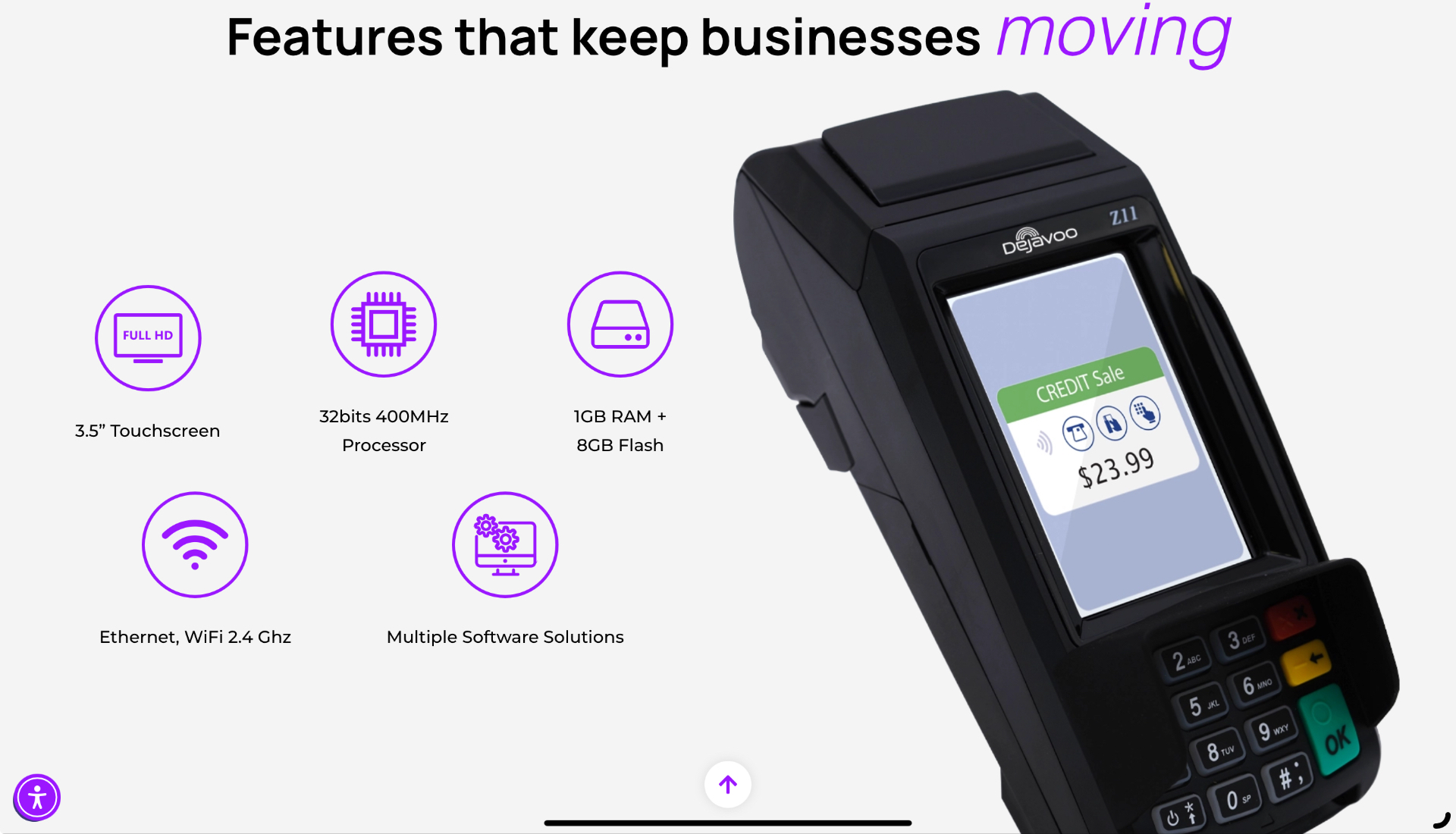
Modern payment terminals from Dejavoo, including the Z11, QD, and P Series: help reduce the steps between “I’m ready to pay” and “Your payment is approved.”
Contactless NFC payments are especially useful. A customer can tap a contactless card or mobile wallet instead of inserting a card, waiting for authorization, and navigating several prompts.
That does not mean every transaction will always take exactly one step. Tips, receipts, signatures, and other business settings may still apply. But contactless removes unnecessary handling and keeps the customer moving.
It also processes as a standard card-present transaction. Contactless does not automatically create a separate cost structure simply because the customer tapped instead of inserted a card. Your actual pricing depends on your processing agreement, card type, and transaction details.
The benefits are practical:
Shorter lines during busy periods.
Fewer abandoned purchases.
Less terminal handling for staff.
More payment options for customers.
A smoother experience for mobile wallets and contactless cards.
A modern terminal also gives you the flexibility to support different business environments. A countertop terminal may work well for a retail counter. A portable device may make more sense for table-side restaurant service, events, or mobile vendors.
The goal is not to buy technology for its own sake. The goal is to make paying easy.
Learn more about the difference between outdated equipment and modern payment terminals for small business.
Online and Phone Payments Need Fewer Handoffs
In-store friction is easy to notice. Online friction can hide in your reports.
You may see that customers opened an order page but did not complete checkout. You may see abandoned bookings or unpaid invoices. But unless you review the payment path yourself, you may not know where customers are getting stuck.
Start by reducing handoffs.
Your online payment experience should avoid sending customers from one unfamiliar platform to another. Whenever possible, use:
Short payment links.
Embedded payment options.
Fewer required fields.
Mobile-friendly checkout pages.
Saved payment methods for returning customers.
Clear confirmation messages.
Consistent branding from order to payment.
For restaurants, CardPlus supports online ordering through Restolabs, helping connect ordering and payment more smoothly. For broader POS needs, GOKUL offers comprehensive POS functionality at super competitive pricing, helping businesses manage more of the customer journey in one connected system.
The right POS systems for small business should do more than ring up a sale. They should help you connect orders, payments, reporting, and customer service without forcing your team to repeat the same work.
Phone payments deserve the same attention.
If your customer has to read card information aloud, wait for a separate invoice, or navigate a complicated portal, the process can stall. A secure virtual terminal or payment link can make it easier to collect payment while maintaining appropriate security and compliance practices.
Your payment provider should help you understand which options fit your business. You should never sacrifice security for speed.

Faster Checkout Can Protect Your Profit Margin
A declined transaction is obvious.
A customer who quietly gives up is harder to measure.
That is why payment friction deserves a place in your profitability review. Every dropped transaction represents revenue you may never recover. You still spent time earning the customer, preparing the product, answering questions, or delivering the service. If the payment fails because the process is inconvenient, the lost sale comes directly out of your margin.
This is also where you should review your credit card processing costs.
Speed and pricing are separate issues, but both affect your bottom line. A faster checkout will not fix an inefficient processing agreement. And a lower rate will not help if customers abandon the payment page.
To understand what you are really paying, calculate your effective rate:
Total processing fees ÷ total card sales × 100 = effective processing rate
Review the result across several months. Look for increases, unexplained fees, equipment charges, and differences between your quoted rate and your actual cost.
Then ask:
Are your transactions being categorized correctly?
Are you paying for features you do not use?
Are outdated terminals causing retries or failed payments?
Does your POS reduce manual entry?
Could a better setup help you save money on processing fees while also improving checkout speed?
A transparent review can uncover both sales leakage and unnecessary expenses.
For more ideas, read 7 POS mistakes that can increase your processing costs.
Run This Three-Step Checkout Audit This Week
You do not need a complicated technology project to find payment friction. Run this quick audit with your team.
1. Count every customer step
Complete a purchase in person, online, and over the phone.
Count everything:
Waiting for an employee.
Choosing a payment type.
Inserting or tapping a card.
Selecting a tip.
Signing a screen.
Opening another app.
Creating an account.
Entering an address.
Confirming an email.
Waiting for a receipt.
Write down the full journey. Do not rely on memory.
2. Test the experience on a phone
Open your online ordering page or payment link from a smartphone.
Ask:
Can a customer understand what to do immediately?
Are the buttons easy to tap?
Are there unnecessary fields?
Does the customer have to log in?
Does the payment page look trustworthy?
Does the confirmation appear right away?
If possible, ask someone unfamiliar with your system to complete the payment. Watch where they hesitate.
3. Remove one barrier now
Choose the biggest source of friction and fix it first.
You might:
Enable contactless payments.
Replace a slow or outdated terminal.
Shorten an online payment form.
Add a direct payment link.
Connect ordering and payment through your POS.
Train staff to bring the terminal to the customer.
Review your statement and effective rate.
Small improvements can create noticeable results when repeated across hundreds of transactions.
Make Paying Easy, Secure, and Worth Completing
The three-step expectation is not just a bill-payment trend. It reflects a broader change in customer behavior.
People expect businesses to respect their time.
Datos Insights CEO David Baxter summarized the finding this way: “Consumers are telling us exactly where their patience runs out: three steps.”
David Albertazzi of Datos Insights added that “step count, login failures, and channel handoffs are conversion metrics” that businesses should measure like checkout abandonment.
That is useful advice for every small business owner.
Review your in-store terminal. Test your online payment path. Examine your phone process. Then look at your processing statement to make sure your payment system is not costing you unnecessary margin.
CardPlus combines modern Dejavoo terminals, industry-focused POS solutions, online payment support, and local service to help your transactions move faster and work more reliably.
Contact CardPlus to review your current setup and find a payment solution built around your business.
Sources
Datos Insights and SBT, “The Competition for Consumer Payments: How Payment Experience Influences Consumer Choice and Payment Priority,” published September 30, 2026. The study surveyed 2,000 U.S. consumers in Q2 2026, with a margin of error of approximately ±2 percentage points.
General checkout-abandonment figures are referenced only as broad industry e-commerce benchmarking. Results vary by industry, device, product, and checkout design.
Comments