
Surcharging Wins: Why Merchant Lawyers Are Cheering for the Surcharge Option in 2026
If you've been watching the payments industry closely, you've probably noticed something interesting happening with surcharging. Merchant lawyers are celebrating, business owners are breathing easier, and the regulatory landscape is finally making sense.
Here's the bottom line: Surcharging has gone from a legal gray area to a legitimate, defensible strategy for managing credit card processing costs in 2026. And that's a win worth talking about.
Source: This post is based on recent industry news and insights from The Strawhecker Group (TSG). For more in-depth coverage of the latest developments in payment processing and financial technology, visit their website at www.tsgpayments.com.
What's Actually Happening with Surcharging?
Let's cut through the noise. Surcharging is the practice of adding a small fee to credit card transactions to offset your processing costs. Instead of absorbing those fees or raising prices across the board, you're giving customers a choice: pay with a credit card and cover the processing fee, or use another payment method at the regular price.
The reason lawyers are cheering? The rules are finally clear, the legal challenges have settled, and merchants have a legitimate path to cost recovery that courts are backing up.

The Legal Landscape: Clearer Than Ever
Here's what's changed. A few years ago, surcharging was murky territory. States had conflicting laws, card networks had confusing rules, and merchants were understandably nervous about implementing programs that might land them in hot water.
Fast forward to 2026, and the picture looks completely different.
Most states now allow surcharging. While California, Connecticut, Massachusetts, and Maine still prohibit the practice entirely, the vast majority of U.S. states have given merchants the green light. Kansas even overturned its surcharge ban back in 2021, joining the growing list of states where surcharging is perfectly legal.
This expansion of legal opportunities is exactly why merchant lawyers are celebrating. They can now confidently advise clients on implementing surcharge programs without constantly looking over their shoulders.
Clear Rules = Happy Lawyers (and Merchants)
The card networks have established well-defined guidelines that provide real legal certainty. No more guessing games.
Here's what you need to know:
Visa caps surcharges at 3% of the transaction amount
Mastercard's limit sits at 4%
Federal regulations allow up to 4% surcharges
You must disclose surcharges clearly before completing transactions
Your payment processor needs 30 days advance notice
Surcharges must appear as separate line items on receipts
Debit and prepaid cards are off-limits for surcharging
This clarity is gold for merchants and their legal advisors. You can structure a compliant surcharging program with confidence, knowing exactly where the boundaries are.
Why This Matters for Your Bottom Line
Let's talk about the real-world impact. Credit card processing fees eat into your margins every single day. For many small businesses, these costs represent 2-3% of revenue just vanishing into thin air.
Surcharging gives you a straightforward way to recover those actual costs from customers who choose credit card payments. You're not raising prices universally. You're not penalizing cash customers. You're simply letting the people who generate the cost bear that cost.
Here's what this looks like in practice:
A $100 sale with a 3% surcharge means the customer pays $103 if they choose credit. That extra $3 covers your processing cost instead of coming straight out of your pocket. Over thousands of transactions, that adds up to real money staying in your business.
Lawyers can defend this as commercially reasonable because it is. You're not profiting from the surcharge: you're recovering your costs. That's a position that holds up legally and ethically.
The Compliance Checklist: Staying on the Right Side
Even with clearer rules, you still need to do surcharging the right way. Here's your practical compliance roadmap:
Before You Start:
Check your state's specific regulations (remember those four states where surcharging is prohibited)
Notify your payment processor at least 30 days in advance
Review your current contracts for any surcharging restrictions
Update your point-of-sale systems to handle surcharge calculations
At the Point of Sale:
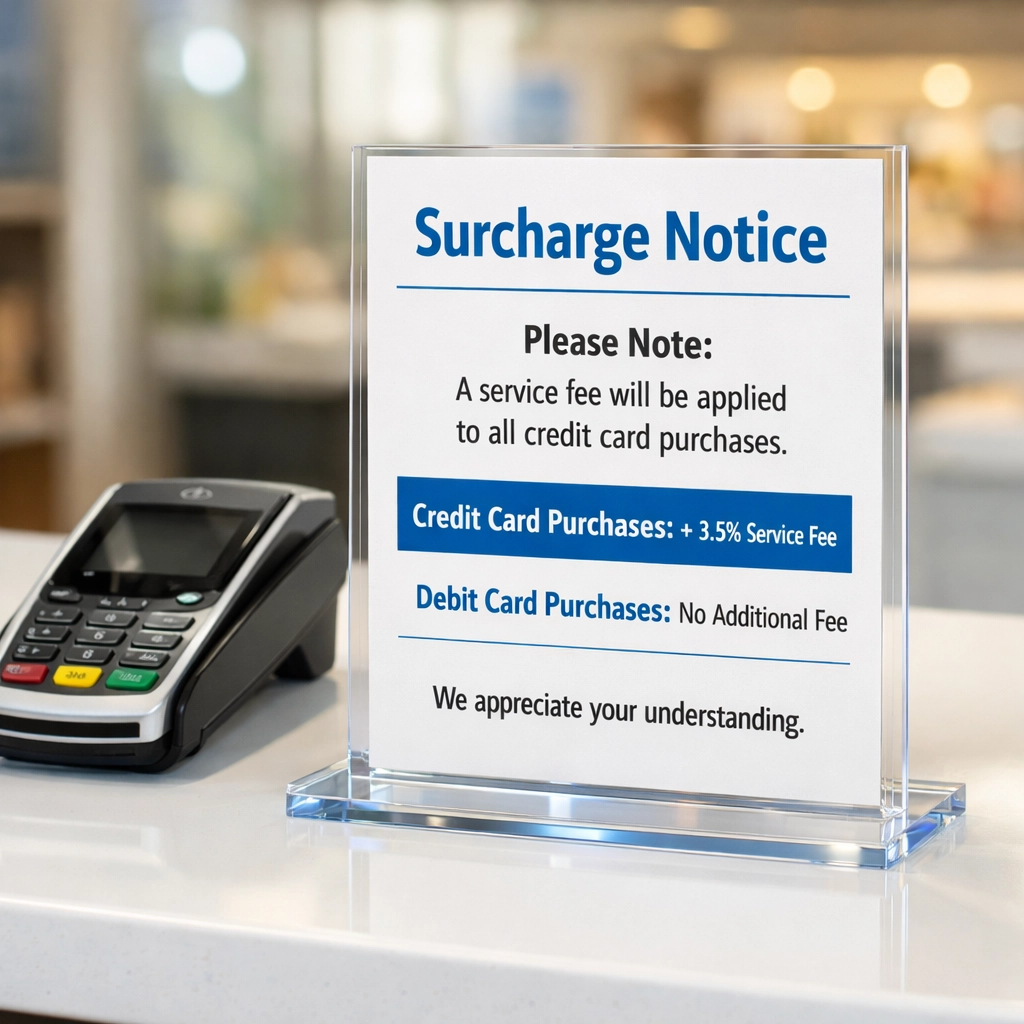
Display clear signage about your surcharge policy at entry points and checkout
Show the surcharge amount before the customer completes the transaction
Print the surcharge as a separate line item on receipts
Train your staff to explain the policy when customers ask questions
Ongoing Maintenance:
Keep surcharges at or below the allowed percentages (3% for Visa, 4% for Mastercard/federal limit)
Never apply surcharges to debit or prepaid card transactions
Maintain records of your actual processing costs to justify your surcharge rate
Review your program regularly to ensure continued compliance
What Agents and ISOs Need to Know
If you're a payment agent or ISO, surcharging represents a massive opportunity to help your merchants save money while strengthening your own value proposition.
Your merchants are asking about fee reduction strategies. Surcharging is one of the most straightforward, legally defensible answers you can provide.
Here's how to position it:
Lead with the legal clarity. Merchants need to know this isn't some sketchy workaround: it's a legitimate business practice backed by clear regulations and court precedent. The lawyers are on board, which should give your merchants confidence.
Emphasize the choice factor. Customers who prefer credit cards understand there's a cost involved. Surcharging makes that cost visible and optional, which is actually more transparent than hiding it in higher base prices.
Talk about the competitive advantage. While some merchants worry about losing customers over surcharges, the reality is different. Many customers accept small surcharges as normal, especially when they see the transparency. And your cash and debit customers get a better deal, which builds loyalty.

The Future Looks Bright for Surcharging
The momentum is clearly in favor of expanded surcharging opportunities. As more states clarify their positions and more merchants implement successful programs, the practice is becoming normalized.
What does this mean for you?
If you're considering surcharging: Now is the time to implement. The legal framework is solid, the technology is proven, and customer acceptance is growing.
If you're already surcharging: Make sure you're following the current guidelines to the letter. Compliance is easier than ever, but it still requires attention to detail.
If you're advising merchants: Lead with confidence. The legal wins around surcharging give you a strong foundation to help your clients reduce costs legitimately.
Your Next Steps
Ready to explore surcharging for your business? Here's what to do:
First, verify your state allows surcharging. Second, calculate your actual processing costs to determine an appropriate surcharge rate. Third, talk to your payment processor about implementation requirements and timelines.
The legal clarity around surcharging in 2026 has created a real opportunity for merchants to take control of their processing costs. With lawyers backing the practice and clear regulations guiding implementation, there's never been a better time to consider this option.
At CardPlus, we help merchants navigate surcharging programs that comply with all regulations while maximizing cost recovery. Our dual pricing solutions make implementation straightforward, and our team understands the legal landscape inside and out.
Want to learn more about how surcharging could work for your business? Get in touch with our team. We'll walk you through your options, help you understand your state's specific requirements, and design a compliant program that protects your bottom line.
The surcharging wins of 2026 aren't just for big corporations with legal departments. They're for every merchant who's tired of watching processing fees eat into their profits. The lawyers are cheering because the path is clear. Now it's your turn to benefit.
Looking for more insights on payment processing strategies? Check out our guide on stopping the waste on processing fees or learn about non-cash adjustment programs to stay compliant.
This article really hit home for me, especially the part about how the merchant lawyers are so optimistic about the surcharge option coming in 2026. It perfectly mirrors my own conclusions from seeing similar situations play out. The breakdown of the concept was so clear, making a complex idea feel quite accessible. I've been wondering myself if surcharging wins is something that truly builds momentum over time, almost like a snowball effect, or if it's more about individual instances https://www.anu.edu.au/ It's fascinating to consider the long-term implications. You’ve definitely gone beyond the surface level here, and I appreciate that depth. Seeing this perspective has also prompted me to reflect on the 'before and after' – what does a business look…